How Many Wedges Should You Carry?
Three wedges or four is the usual question, but the number is downstream of a simpler one: where are the gaps in your bag, and how many scoring shots do you actually hit? Get those right and the count answers itself.
April 9, 2025
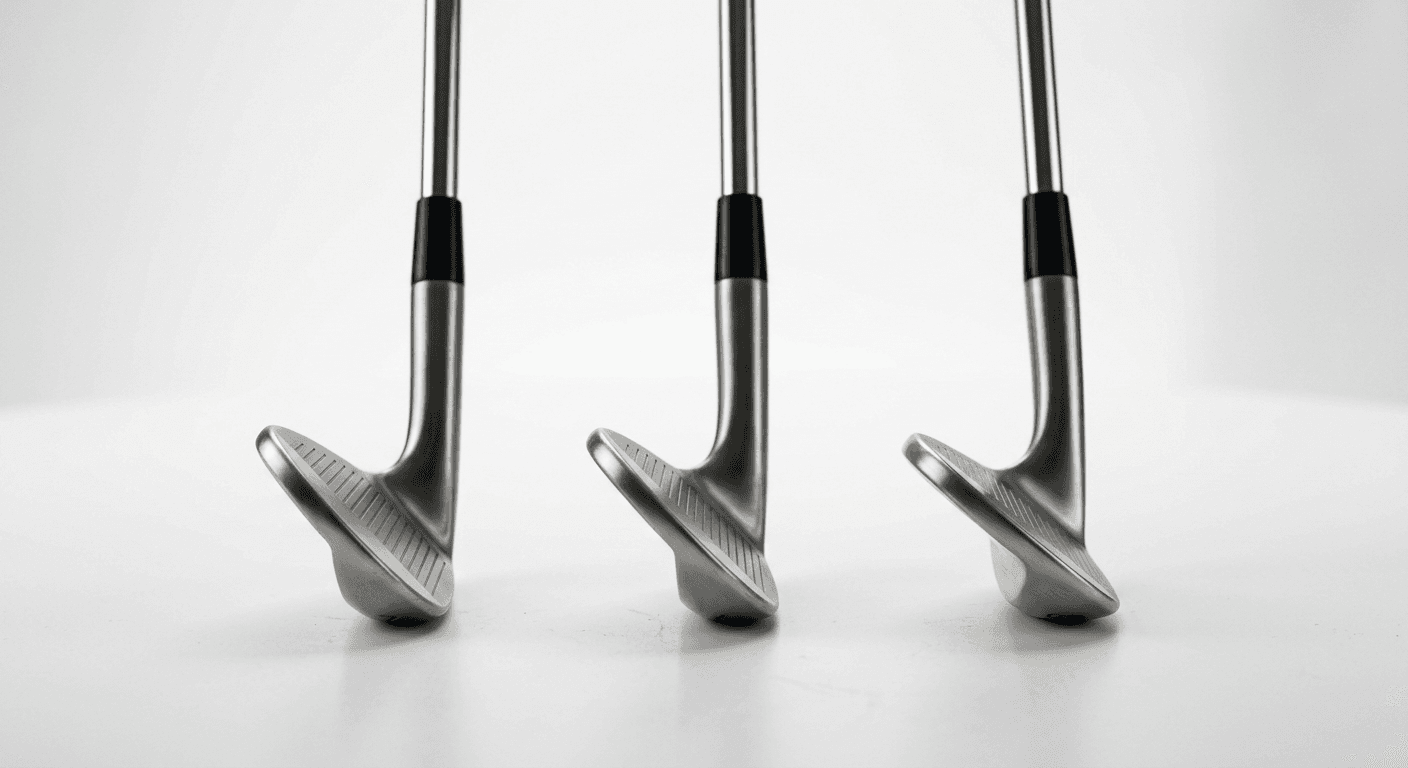
The right wedge setup fills the gap below your pitching wedge without leaving holes
Ask a range full of golfers how many wedges they carry and you will hear three, four, and the occasional two, all delivered with total confidence. None of those answers is wrong on its own, because the count is not the real question. What matters is whether your wedges cover the distances below your full irons with even gaps, and whether the shots you carry match the shots you actually face. Sort that out and the number falls out naturally.
Here is how to build a wedge setup that fits your bag and your game, starting from the one club that quietly dictates everything else: your pitching wedge.
The two common setups
Almost every golfer lands on one of two arrangements. The three-wedge setup is a pitching wedge, a gap wedge (also called an approach wedge), and a sand wedge. It is simple, it covers most players, and it keeps a slot open for another club you might use more, like a hybrid or a fifth fairway.
The four-wedge setup adds a lob wedge, usually around 58 to 60 degrees, on the bottom end. This gives you a dedicated club for short, high, soft shots and for bunkers where you have little green to land on. It is popular with lower handicaps and with anyone who plays firm, fast courses where stopping the ball is hard.
Why gapping is the whole game
The reason to care about wedge count at all is distance gapping. Every club in the bag should carry a predictable yardage, and the steps between clubs should be even. If one club carries 110 and the next carries 95, that 15-yard gap is fine. If the gap balloons to 25 yards because a wedge is missing, you are left choking down or forcing a shot on the most important yardages in golf, the ones inside full swing range where you should be scoring.
The rough guideline most fitters use is to keep about 4 to 6 degrees of loft between wedges. That spacing tends to produce even distance gaps for a typical swing. Go much wider and you leave a hole in your yardages. Go much tighter, like 3 degrees, and two wedges fly nearly the same distance, which wastes a slot you could use elsewhere.
Count the gaps, not the wedges.
A good setup has no loft gap larger than about 6 degrees between your pitching wedge and your highest-lofted wedge. If a gap is bigger than that, you are missing a club. If two wedges are within 3 degrees, one of them is probably redundant.
Your pitching wedge sets the top of the stack
Here is the part most golfers overlook. Your wedges are not a separate purchase from your irons. Your pitching wedge is the top of the wedge stack, and its loft decides how much room you have to fill below it.
That matters more than it used to because pitching wedge lofts have crept stronger. A traditional pitching wedge was around 46 to 48 degrees. Modern game-improvement irons have strengthened that to roughly 43 to 44 degrees to chase distance, so today two golfers can both carry a club stamped PW that are three or four degrees apart in loft. The stronger your pitching wedge, the bigger the gap down to a standard 54 or 56 degree sand wedge, and the more likely you need a gap wedge to bridge it. If you want the background on why lofts moved, see our guide to iron loft creep.
Example lofts and gapping
The table below shows how a sensible wedge stack changes with your pitching wedge loft. These are starting points, not gospel; check the actual lofts stamped on your irons, since the same PW label can mean different things.
| Your PW loft | Gap wedge | Sand wedge | Lob wedge |
|---|---|---|---|
| 43 to 44 (strong, modern) | 48 | 52 or 54 | 58 |
| 45 to 46 (in between) | 50 | 54 or 56 | 58 or 60 |
| 47 to 48 (traditional) | 52 | 56 | 60 |
Notice how the strong-lofted PW forces a gap wedge just to keep the steps even, while a traditional PW leaves more room and lets you spread three wedges comfortably. This is exactly why so many players with modern irons end up carrying four wedges without ever deciding to.
Match the count to the shots you hit
Gapping tells you where the holes are. Your short game tells you how far down to go. Think about the scoring shots you actually face on your courses. If you play soft, receptive greens and mostly hit pitches and chips that release, you may never need a 60 degree wedge, and a clean three-wedge setup will serve you well.
If you play firm courses, short-side yourself often, or like to hit high, spinning shots that land soft, a lob wedge earns its keep. And if you honestly do not hit many finesse shots and could use another long club more, there is nothing wrong with carrying three wedges and putting that slot to better use. The bag has fourteen spots and every one should do a job.
Bounce and grind, briefly
Two wedges with the same loft can perform very differently because of bounce and grind. Bounce is the angle on the sole that keeps the leading edge from digging into the turf. Higher bounce, around 10 to 14 degrees, helps in soft turf, fluffy bunkers, and for players who take a steep, digging divot. Lower bounce, around 4 to 8 degrees, works on firm ground, tight lies, and for shallow, sweeping swings.
Grind is the shaping of the sole, how much material is ground away at the heel, toe, or trailing edge, which changes how the wedge sits when you open the face or hit from awkward lies. You do not need to master the chart. The practical version is this: put more bounce on your sand wedge, keep moderate bounce on your gap and lob wedges, and lean lower if your courses are firm or higher if they are soft. If you want to see how specific wedges are set up, the wedge database lists loft, bounce, and grind options for current models.
A recommended setup by player type
Higher handicaps and newer players: keep it to three wedges. A pitching wedge, a gap wedge, and a sand wedge cover almost every shot you will hit, and a 54 to 56 degree sand wedge is far easier to strike consistently than a 60. Skip the lob wedge until your contact is reliable.
Mid handicaps: three or four wedges depending on your courses. If your greens are firm or you like a soft short game, add a 58 or 60. If not, stay at three and use the slot elsewhere. Get your gaps checked either way, because a strong-lofted modern PW often hides a missing gap wedge.
Lower handicaps and better ball-strikers: four wedges is the norm. You hit enough varied scoring shots to justify a dedicated lob wedge, and you have the control to use higher-lofted, lower-bounce wedges around firm greens.
How to build your setup
Start by writing down the loft of your pitching wedge, then fill in wedges below it in 4 to 6 degree steps until you reach your highest-lofted wedge. Check the resulting distance gaps on a launch monitor if you can, because loft steps do not always translate into perfectly even yardages for every swing. Then match bounce to your turf and your strike, and cut the setup off wherever your short game stops asking for more loft.
To make this concrete, the wedge gap tool maps your current wedges and flags any gaps or overlaps, and the free club finder can suggest wedges that fit the distances you need to cover. If you are ready to buy, our best wedges guide covers the current models worth a look.
Frequently asked questions
Is three or four wedges better?
Neither is better in the abstract. Three wedges keeps a slot free and covers most golfers. Four adds a lob wedge for short, high, soft shots and firm-course bunkers. Choose based on your gapping and how many finesse shots you actually hit, not on what better players carry.
What sand wedge loft should I use?
A 54 to 56 degree sand wedge suits most players. It is versatile enough for bunkers, pitches, and chips, and it is easier to strike than a 60. If you carry a lob wedge below it, a 54 sand wedge keeps your gaps even; if the sand wedge is your highest-lofted club, 56 gives you a bit more loft for short shots.
Can I carry two wedges instead of three?
You can, and some players do to free up slots for more long clubs. The risk is a large distance gap below your pitching wedge, which leaves you with awkward part-swing yardages. If you go with two, make sure a pitching wedge and a single sand wedge do not leave a hole bigger than about 6 degrees, or you will feel it on scoring shots.
Do my wedges need to match my irons?
Only your pitching wedge, and often not even that. Many players carry the pitching wedge from their iron set and then use dedicated specialty wedges below it for better spin, sole options, and feel. What matters is that the loft of your set pitching wedge lines up with the first specialty wedge below it so the gap stays even.