Iron Loft Creep: Are Modern Irons Actually Longer?
Your new 7-iron flies ten yards past your old one, and the box says it is the technology. Most of the time it is the loft. Here is how far iron lofts have crept, why manufacturers keep strengthening them, and what it actually does to your bag.
July 7, 2026
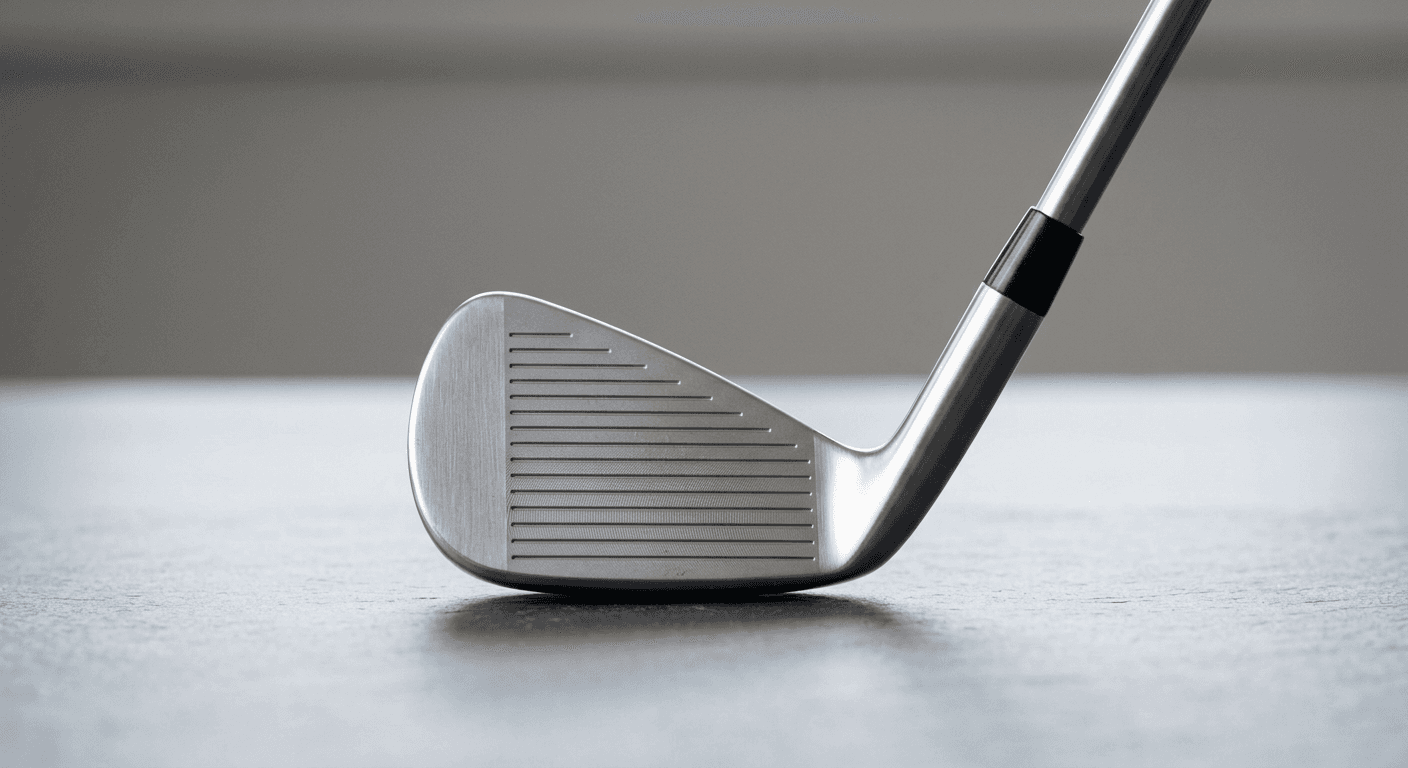
The same 7-iron number now hides a much stronger loft than it did a decade ago
Hit a demo 7-iron at a fitting and it flies past your gamer, and the temptation is to credit the face technology, the tungsten, the marketing word of the season. Some of that is real. But the biggest reason a new 7-iron outdrives an old one is quieter and a lot less flattering: the new club simply has a stronger loft. It is closer to what used to be a 6-iron.
This is loft creep, and it has reshaped what the number on the bottom of an iron actually means. Understanding it changes how you shop, how you compare sets, and how you build the bottom of your bag.
What loft creep is
Iron lofts have been getting stronger for decades. Manufacturers shave a degree or two off each club with most new releases, so the drift is slow enough that no single set feels dramatic. Stack up fifteen years of it and the shift is large. A 7-iron that was 34 degrees in the mid-2000s is often 28 degrees today in a game-improvement set.
The label never changed. It still says 7. But a 28-degree 7-iron and a 34-degree 7-iron are different clubs, and the newer one will carry noticeably farther for the same swing.
How much 7-iron lofts have crept
These are typical 7-iron lofts for a mainstream game-improvement iron by era. Individual models vary, but the direction is consistent.
| Era | Typical 7-iron loft |
|---|---|
| Mid 2000s | 34 degrees |
| Around 2010 | 32 degrees |
| Around 2015 | 30.5 degrees |
| Around 2020 | 28.5 degrees |
| 2025-2026 | 27-28 degrees |
Roughly six degrees of strengthening over twenty years. Six degrees is about the gap between two numbered irons, which means a modern distance 7-iron is, in loft terms, close to a 2000s-era 5-iron.
Loft depends heavily on the category
Loft creep is not uniform across the market. It is concentrated in the categories that sell on distance. Players irons and blades have stayed close to traditional lofts because their buyers want control and predictable gapping, not a longer number.
| Iron category | Typical 7-iron loft |
|---|---|
| Blade / players | 34 degrees |
| Players cavity | 33 degrees |
| Players distance | 30-31 degrees |
| Game improvement | 28-30 degrees |
| Super game improvement / distance | 26-28 degrees |
There is an eight-degree spread between a blade and a distance iron at the same number. That is why a player who switches from a players iron to a distance iron can gain a full club of carry without swinging any faster, and why comparing the two by their stamped numbers tells you nothing useful.
A stronger 7-iron is not more distance out of thin air.
It is the same swing delivering a stronger club. You gain carry on that one iron, but you give it back at the top and bottom of the set, because the whole ladder shifts with it.
Why manufacturers do it
Distance sells irons, and the easiest place to demonstrate distance is a launch monitor comparison where a shopper hits the new 7-iron next to their old 7-iron. If the new club is two degrees stronger, it will read longer, and the number on the screen does the selling. It is a real gain on that club, just not the gain the marketing implies.
The important part is that strong lofts only work because the rest of the iron changed to support them. Modern game-improvement heads push the center of gravity low and deep and pair with light, active shafts, all of which add launch and spin back. That is what keeps a 28-degree 7-iron in the air. Strengthen the loft without that engineering and you get a low, running shot that will not hold a green.
What loft creep does to your bag
The number that gets ignored in the demo is the pitching wedge. When the set gets stronger, the wedge comes with it.
| Set type | Pitching wedge loft | Wedge you now need |
|---|---|---|
| Traditional | 47-48 degrees | 52 and 56 |
| Modern game improvement | 43-44 degrees | 48, 52 and 56 |
| Distance iron | 41-43 degrees | 46 or 48, then 52 and 56 |
A 43-degree pitching wedge leaves a big hole down to a standard 54 to 56 degree sand wedge, so strong-lofted sets almost always need an extra gap wedge around 48 to 50 degrees. The distance you gained on the 7-iron gets spent buying and fitting another wedge to fill the space the strong loft opened up.
The same thing happens at the top of the set. A strong 4-iron or 5-iron gets harder to launch and hold a green, which is why so many players replace their longest irons with hybrids. The set did not just get longer. It shifted, and the ends fell off.
How to shop around it
None of this makes strong lofts bad. A distance iron that fits your speed and launches high enough is a genuinely good club. The mistake is comparing sets by their numbers instead of their lofts.
When you compare two sets, line up the lofts, not the labels. A 30-degree 7-iron and a 27-degree 7-iron are three degrees and most of a club apart. Look at the full loft chart, check the gaps between clubs, and pay attention to where the set ends and what you will need to add. Our guide to reading iron loft charts walks through exactly how to do that.
If you want to skip the manual comparison, the iron database lists the full loft chart for every set, and the free club finder matches sets to your carry distances so lofts are compared on an even footing rather than by the number stamped on the sole.
Frequently asked questions
Is a stronger-lofted iron better?
It is better for carry if it fits your speed and still launches high enough to land soft. It is worse if the strong loft drops your flight so low that the ball runs through greens. Fit matters more than the loft number in isolation.
Does loft creep mean I actually hit it farther, or is it a trick?
Both are true. You really do carry that individual iron farther, because it is a stronger club. It is a trick only in the sense that a stronger 7-iron is not the same 7-iron you used to play, so the comparison is not apples to apples.
How do I compare a 28-degree 7-iron to a 31-degree 7-iron?
Ignore the number and match the lofts. The 28-degree 7-iron competes with the other set's 6-iron. Compare carry distances at matched lofts and the "extra distance" of the stronger set mostly disappears. See our iron buying guide for how to weigh distance against forgiveness and feel.
Do stronger lofts hurt distance gapping?
They can. Strong lofts push the wedges apart at the bottom and make the long irons harder at the top. Even gapping is achievable, but a strong-lofted set usually needs an added gap wedge and often a hybrid or two to keep consistent spacing from the longest club to the shortest.