Titleist T150 vs T200 Irons: Which Fits Your Game?
Both live in Titleist's players-distance family, and from a few feet away they can look like the same iron. They are not. One is built for the golfer who flushes it and wants a clean, penetrating flight; the other adds forgiveness and launch for the golfer who wants distance without the sweat. Here is how to tell which one is yours.
February 19, 2025
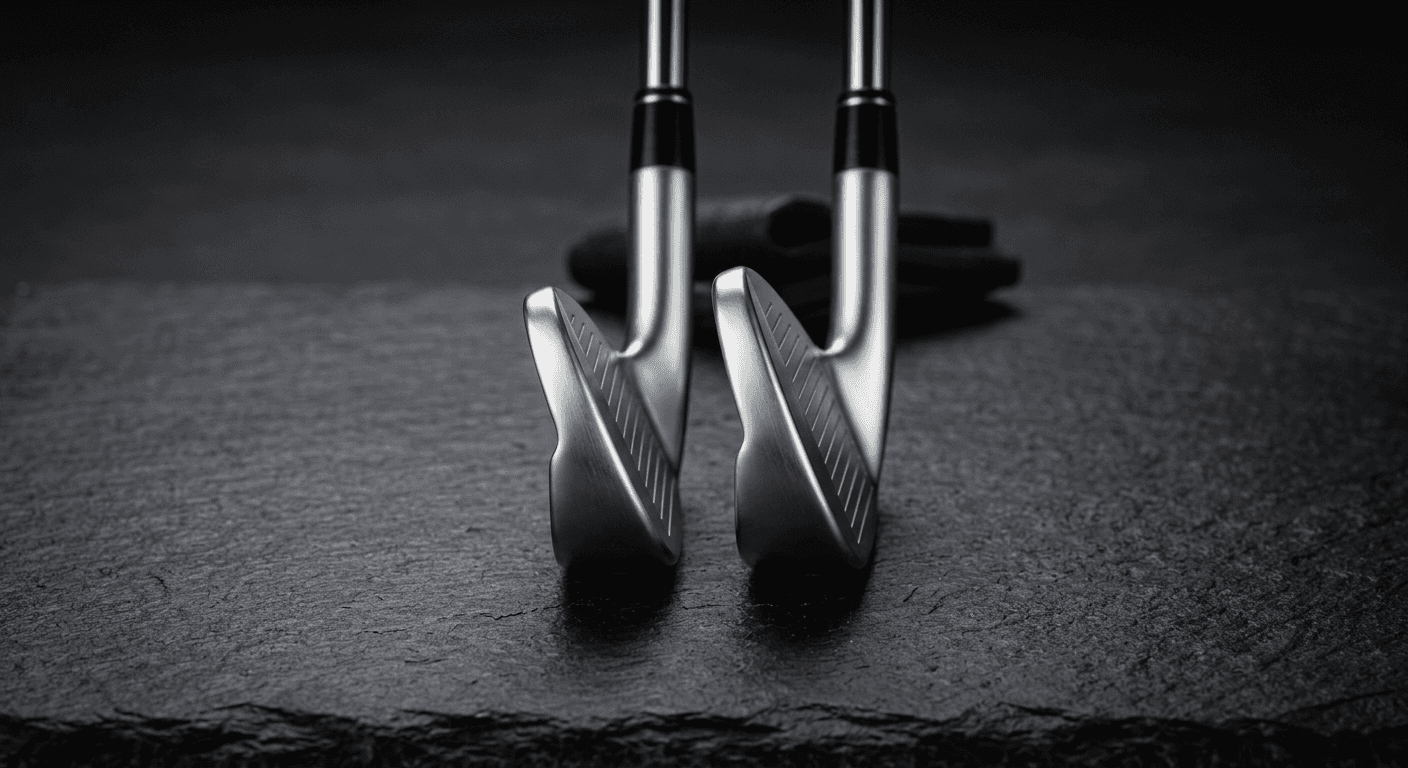
The T150 is the more compact players-distance iron; the T200 adds forgiveness and launch
Titleist sells more than one players-distance iron on purpose. The T150 and the T200 target the same broad goal, distance with a shape that still looks like a player's iron, but they get there in different ways and reward different swings. Pick the wrong one and you either fight a head that is too demanding or bag one that hides feedback you would rather feel.
Here is what actually separates them, and how to figure out which side of the line your game sits on.
The short version
The T150 is the more compact, more demanding of the two. Thinner topline, less offset, stronger lofts, and a flatter, more penetrating flight. It is aimed at the golfer who catches the middle of the face often and wants a clean look and a workable ball flight without dropping all the way down to a blade.
The T200 keeps a similar players-distance identity but leans on a hollow-body, max-impact construction with more tungsten. That gets the ball up higher and holds ball speed better on mishits. It suits a wider range of players who still want a tidy head but would rather have the forgiveness and easier launch than the last bit of workability.
| Attribute | Titleist T150 | Titleist T200 |
|---|---|---|
| Look / shape | Compact, thin topline | Clean but slightly larger |
| Offset | Less | A touch more |
| Forgiveness | Good for the class | More forgiving |
| Launch / flight | Lower, penetrating | Higher, easier |
| Lofts | Stronger | Slightly weaker |
| Best for | Consistent ball-strikers | Wider range of players |
Look and shape at address
Set both behind the ball and the T150 reads smaller. The topline is thinner, the offset is reduced, and the whole head has a more compact footprint. For a good ball-striker that is reassuring rather than intimidating: less club between the eye and the ball, and a shape that hints at control.
The T200 is not a bulky head, but it gives up a little of that trim look for the internal volume its construction needs. The topline is slightly fuller and there is a touch more offset. Most players will not find it clunky, and if you like a sliver of extra confidence at address, that fuller look is a feature, not a compromise.
Forgiveness and where the misses go
This is the clearest split. The T200's hollow body and heavier tungsten loading push weight low and to the edges, which is exactly what protects ball speed and launch when you catch it off center. Thin strikes stay closer to your stock number and toe misses do not bleed as much distance.
The T150 is still forgiving for its category, well clear of a blade, but it is built tighter. When you miss, it tells you, and it gives back a little more distance and dispersion than the T200 would on the same strike. That feedback is part of the appeal if you strike it well and want to know what you did. It is a liability if your contact still wanders.
The real question is your strike, not your ego.
Both look like a player's iron in the bag, so neither one embarrasses you. Pick the T150 if your contact is genuinely consistent and you want the flight and feedback. Pick the T200 if an honest look at your misses says you would score better with the extra help.
Launch and flight
The T200 launches higher and lands softer. The low tungsten and hollow construction get the ball up without needing a weak loft, which helps if you struggle to hold greens or want more carry from your long irons. If your natural flight is on the low side, the T200 can add the height you have been missing.
The T150 flies lower and more penetrating. Stronger lofts and a more compact head produce a flatter trajectory that many good players prefer for control, especially into wind and on firm turf. You give up some stopping power for a flight you can shape and trust. A note on the lofts: the T150 runs stronger, on the order of a degree or so per club, but exact numbers vary by club and model year, so check the current spec sheet rather than trusting a round figure.
Feel
Both feel good for players-distance irons, and Titleist tunes them to sound and feel solid rather than hot and clicky. The T150, being more compact and a touch more traditional in construction, tends to give slightly more connected feedback at impact, which pairs with the audience it is built for. The T200's hollow body feels solid and a little more muted; you sense a good strike, but the head does more to smooth over the bad ones. Neither feels cheap. This is a small preference on top of the bigger forgiveness and flight decision, not a reason to choose on its own.
Who each one fits
The T150 fits the golfer who finds the center of the face regularly, wants a compact head with minimal offset, and values a penetrating, workable flight over maximum help. If you are moving down from a game-improvement iron because your strike has tightened up, or across from a blade because you want a bit more forgiveness without changing the look much, the T150 is the natural stop.
The T200 fits a wider band of players who want distance and a clean look but would rather have the forgiveness and easier launch. If your contact is good but not machine-consistent, or you need more height to hold greens, the T200 gives you the players-distance profile with a bigger margin for error.
If you are still deciding whether you belong in players-distance irons at all, our players-distance vs game-improvement guide lays out the whole spectrum so you can place your game before you narrow down to two models.
How to decide
Do not settle this on looks or on which name sounds more like a better player. Hit both on a launch monitor and read the numbers that matter: carry, dispersion, launch, and how the misses behave. If the T150's misses stay tight, take the flight and feedback. If they scatter, the T200 will score better for you, full stop.
To line them up against the rest of the field first, the free club finder matches iron sets to your carry distances, the iron database lists the category and specs for both models and their rivals, and the T150 vs T200 comparison page puts them head to head. For a broader primer on matching an iron to your game, see our iron buying guide.
Frequently asked questions
Is the T150 or T200 more forgiving?
The T200. Its hollow body and internal tungsten hold ball speed and launch better on off-center strikes. The T150 is still forgiving for a players-distance iron, but it is built tighter and gives back a little more on a miss in exchange for its compact shape and workable flight.
Which one launches higher?
The T200. The low tungsten loading and hollow construction help get the ball up with a stronger effective loft, which is useful if you need more carry or steeper landing angles. The T150 flies lower and more penetrating, which better ball-strikers tend to prefer for control and wind.
Are the T150 lofts stronger than the T200?
Yes, on the stronger side, roughly a degree or so per club depending on which club and model year you are looking at. That is part of why the T150 flies lower and a touch farther per number. Check the current spec sheet for exact figures rather than assuming.
Can a mid-handicapper play the T150?
Some can, if their contact is genuinely consistent, but many mid-handicappers are better served by the T200's extra forgiveness or even a step further into game-improvement. Be honest about your misses before you reach for the more compact head. If you are unsure where you land, the iron buying guide walks through how to judge it.