Titleist GTs2 vs GTs3 vs GTs4: Which Driver Fits Your Swing in 2026?
Titleist's 2026 GTs lineup splits cleanly across speed, spin, and CG position. Here's how to choose between the GTs2, GTs3, and GTs4, with the launch numbers that actually matter.
May 13, 2026
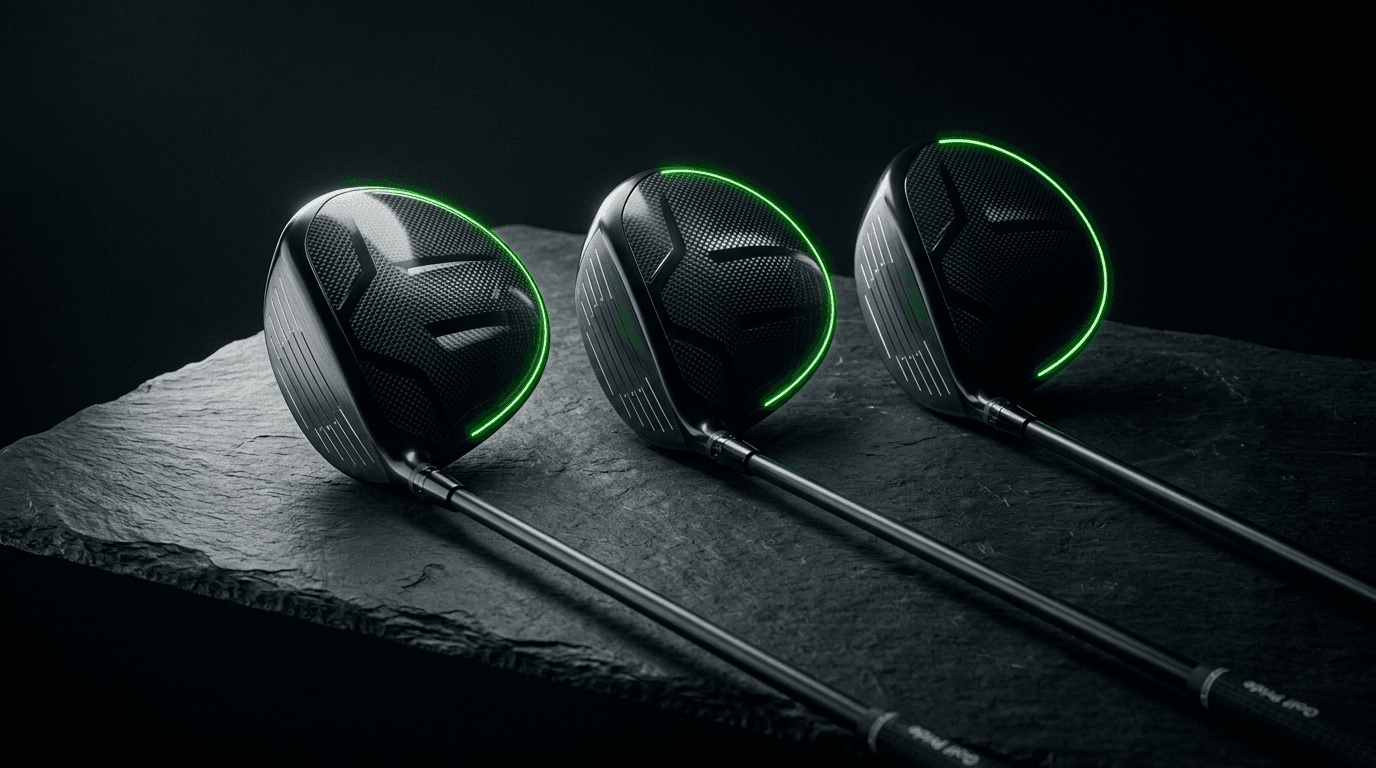
The 2026 Titleist GTs lineup, three heads, three CG positions, three swing profiles
The 2026 Titleist GTs Lineup, Explained
Titleist's 2026 GTs lineup is a refinement of the GT generation that preceded it, not a reinvention. The shaping is familiar, a low-profile pear silhouette, a refined matte crown, and an adjustable hosel with the same Titleist SureFit interface that has carried over multiple cycles. What changed is what is happening under the crown. The GTs heads use a new variable-density forged ring construction that lets Titleist redistribute mass in ways the GT could not, which is why the three production heads, GTs2, GTs3, and GTs4, feel more distinct from each other than any previous Titleist lineup.
That clean separation is the reason this lineup is interesting. Most three-head driver lineups leave a fitter doing process-of-elimination, "not the player's head, not the GI head, so this one", and most golfers end up in the middle option by default. The GTs splits more cleanly. There is a head for the swing that needs help getting the ball in the air, a head for the swing that needs help bringing spin down, and a head for the swing that needs to dial in weight position by ball flight rather than by category. If you understand the differences, you can almost predict which one will fit before you hit a single shot.
The GTs2: High Launch, High MOI, Most Forgiving
The GTs2 carries forward the role the GT2 played in the prior generation, the head for the mid-to-low handicap golfer who wants forgiveness without giving up workability entirely. The crown silhouette is slightly squarer at address than the GTs3, and the toe section is thicker, which moves more mass toward the heel-toe extremes and raises MOI. For golfers whose contact varies across the face, that extra MOI translates to less ball-speed loss on heel and toe strikes and a tighter overall dispersion.
Launch is the other GTs2 story. Titleist positions the GTs2's center of gravity low and slightly back, which produces a higher launch angle and more spin than the GTs3 or GTs4 at the same loft. For golfers who already get steep angle of attack and high spin, that combination can produce ballooning trajectories. For golfers whose drives flatten out prematurely or lack carry, the GTs2 adds yards by getting the ball into the optimal launch window without forcing a swing change.
Stock lofts run 9 degrees, 10.5 degrees, and 12 degrees. The 12-degree option is the most underrated head in the lineup, for golfers under 90 mph swing speed, the extra loft adds carry distance that more than offsets the small spin penalty, and most clubfitters will recommend a 12 over a 10.5 for that speed range even when the player asks for "less loft."
Best fit profile: swing speeds 85 to 100 mph, MID_HANDICAP and below, golfers who fight low launch or inconsistent contact. The full GTs2 specs and variants are here.
The GTs3: Low Spin, Mid Launch, Players-Distance Standard
The GTs3 is the head most tour players in the Titleist stable will end up in. It is the traditional player's distance driver, slightly deeper face, slightly more pear-shaped than the GTs2, and a CG that sits lower and more forward, producing a lower launch and meaningfully less spin. For golfers who already launch the ball high and need to bring backspin down to flatten trajectory and run out more, the GTs3 is the obvious answer.
The forgiveness gap between GTs2 and GTs3 is smaller than the gap between most companies' equivalent heads. The GTs3 still ranks high on MOI relative to other tour-shaped drivers, and off-center strikes lose less ball speed than the previous GT3. The trade-off is that the forward CG amplifies any over-the-top swing motion, a heel strike with a slight out-to-in path can produce a more dramatic left miss than the GTs2 would have on the same swing.
Stock lofts are 8, 9, and 10 degrees. The 9 is the most commonly fit option for swings in the 95-110 mph range. The 10 degree head is a sleeper for golfers who like the GTs3 shape and feel but want a slightly higher launch without giving up the low-spin profile.
Best fit profile: swing speeds 95 to 115 mph, MID to LOW handicap, golfers who spin the ball too much or want a flatter trajectory. GTs3 specs and shaft options live on the model page.
The GTs4: Adjustable Track, Tunable CG, Highest Ceiling
The GTs4 is the head Titleist built for fitters and for players who already know what they want a driver to do. The defining feature is the rear sole track and the movable weight that rides inside it. Sliding the weight to the heel produces a draw-biased shot shape and a slightly higher launch. Sliding it to the toe produces a fade-biased shape and a marginally lower launch. Centering the weight gives the lowest spin in the lineup.
For most golfers, that adjustability does not matter. They will buy the head, leave the weight where the fitter set it, and get the same performance they would from a GTs3. The argument for the GTs4 is for golfers who fight a single dominant miss, a chronic fade or a chronic pull, and need shape correction beyond what an adjustable hosel can deliver. In those cases, the GTs4's weight track moves dispersion by 8 to 12 yards in the desired direction, which a hosel adjustment alone will not match.
The GTs4 is also the lowest-spin head in the lineup when the weight is centered. For high-swing-speed players (115 mph+) whose spin is the limiting factor in distance, the GTs4 can deliver 200 to 400 RPM less than the GTs3 with the same loft and shaft. That is the difference between a 290-yard carry that hangs in the air and a 295-yard carry that runs out to 315 total.
Stock lofts are 8, 9, and 10 degrees. Available across the same SureFit interface as the other GTs heads, so shaft and loft adjustments are interchangeable.
Best fit profile: swing speeds 110 mph+, LOW handicap, golfers with a strong directional miss or who need to manage spin at the top of the speed range. GTs4 model page has the variant grid.
Launch Conditions: How To Read The Numbers
Driver fitting comes down to three launch-monitor numbers: launch angle, spin rate, and smash factor. The optimal combination depends on swing speed.
- Under 90 mph: Optimal launch is 14°-17°, optimal spin 2,600-3,100 RPM. GTs2 with 12° head is the most common fit.
- 90-100 mph: Optimal launch 13°-15°, spin 2,400-2,800 RPM. GTs2 (10.5°) or GTs3 (10°) depending on natural launch.
- 100-110 mph: Optimal launch 12°-14°, spin 2,100-2,500 RPM. GTs3 (9° or 10°) is the most common fit.
- 110 mph+: Optimal launch 11°-13°, spin 1,800-2,200 RPM. GTs3 (8° or 9°) or GTs4 for spin control.
These are starting points, not prescriptions. A 95 mph swing with a steep angle of attack and a high spin profile may actually need the lower-spin GTs3 instead of the higher-launching GTs2. The only way to know for certain is to put a launch monitor on a few swings. The Find My Driver tool narrows the candidate list before you book a fitting.
Shafts: The Variable That Changes Everything
The GTs heads ship with stock shafts that cover most fit profiles, the Mitsubishi Diamana D series and the Fujikura Ventus Blue are the high-volume choices for the GTs3, and the Fujikura Ventus Blue 5 in regular flex is the stock GTs2 option for slower swings. Most golfers will be fit into one of these stock shafts.
The point worth making: the head choice matters less than the shaft choice for most amateurs. A GTs3 with the right shaft will outperform a GTs2 with the wrong shaft for almost any swing profile. If you are spending $700 on a new driver, do not skip the shaft fitting to save 20 minutes. The shaft determines launch, spin, and timing, the head is the carrier.
How To Pick Without Spending A Day In A Fitting Bay
If you have to choose without a launch monitor session, work backward from your dominant miss and your current driver.
If your current driver feels like it balloons or you lose distance because the ball climbs instead of carrying, the GTs3 is almost certainly the right answer. If your current driver feels like the ball falls out of the sky too soon or you wish you had more carry, the GTs2 is the move. If your current driver is fine in feel but you fight a directional miss you cannot eliminate with hosel adjustments, the GTs4 gives you a tool that hosel adjustment alone cannot.
For golfers swinging under 95 mph, the GTs2 is the default. The GTs3 will work, but it asks a lot of swing speed to produce optimal launch and spin without the additional CG help. The GTs2's higher launch and forgiveness are worth more than the GTs3's spin reduction at that speed.
For golfers swinging over 105 mph, the GTs3 is the default and the GTs4 is the upgrade if spin is the problem. The GTs2 at that speed produces too much spin and too high a launch, and the gains in MOI do not offset the loss in efficient ball flight.
What About The GTs Fairway And Hybrid?
Titleist also released GTs2 Fairway, GTs3 Fairway, and GTs Hybrid models alongside the driver lineup. The fairway lineup follows the same logic, GTs2 is higher launch and more forgiving, GTs3 is lower spin and more compact. The GTs Hybrid is a single model that covers the gap between fairway and irons with adjustable hosel and a medium-large head profile.
The matched-set logic that worked for the GT generation still applies. Players who get fit into a GTs2 driver should look first at the GTs2 Fairway. Players who fit the GTs3 driver will usually fit the GTs3 Fairway. The CG philosophy is consistent across the head series, which makes the bag-gap math cleaner.
Browse the full Titleist fairway wood lineup to compare specs and shafts.
How GolfSource Scores The GTs Heads
Our MatchScore engine ranks the GTs heads against the full driver field across the same nine dimensions: head size, loft optimization, shaft fit, category fit, miss tendency, swing speed match, launch conditions, spin control, and category-relative forgiveness. The full breakdown is available on each model page, but the headline is that the GTs3 is the highest-scoring head for the 95-110 mph mid-handicap player, the GTs2 is the highest-scoring head under 95 mph, and the GTs4 is the highest-scoring head over 110 mph with above-average spin.
That is not a coincidence, it's exactly the alignment Titleist designed the lineup for. If you are in any of those buckets, the corresponding head is almost certainly your best Titleist option, and probably one of your top two or three options across all 2026 driver releases.
Run your own profile through the Find My Driver tool and the GTs heads should be near the top of your shortlist if Titleist's shaping and feel match your eye. If your dispersion data doesn't match the head fit profile, MatchScore will tell you and rank a different head higher.