Data Guide · July 17, 2026
How to Read a Launch Monitor: The Numbers That Actually Matter
A launch monitor throws 15 numbers at you and only about 6 change what club you should buy. Here is what ball speed, smash factor, spin, launch, angle of attack, and carry actually tell you, and which readouts to ignore.
Walk into any fitting bay or indoor sim these days and a launch monitor is running. It spits out a wall of numbers after every swing, and most golfers nod along while quietly having no idea which ones matter. That is a shame, because the same screen fitters use to sell you a driver can tell you exactly why your current one is costing you distance. You do not need a degree to read it. You need to know which six numbers to look at and what a good one looks like.
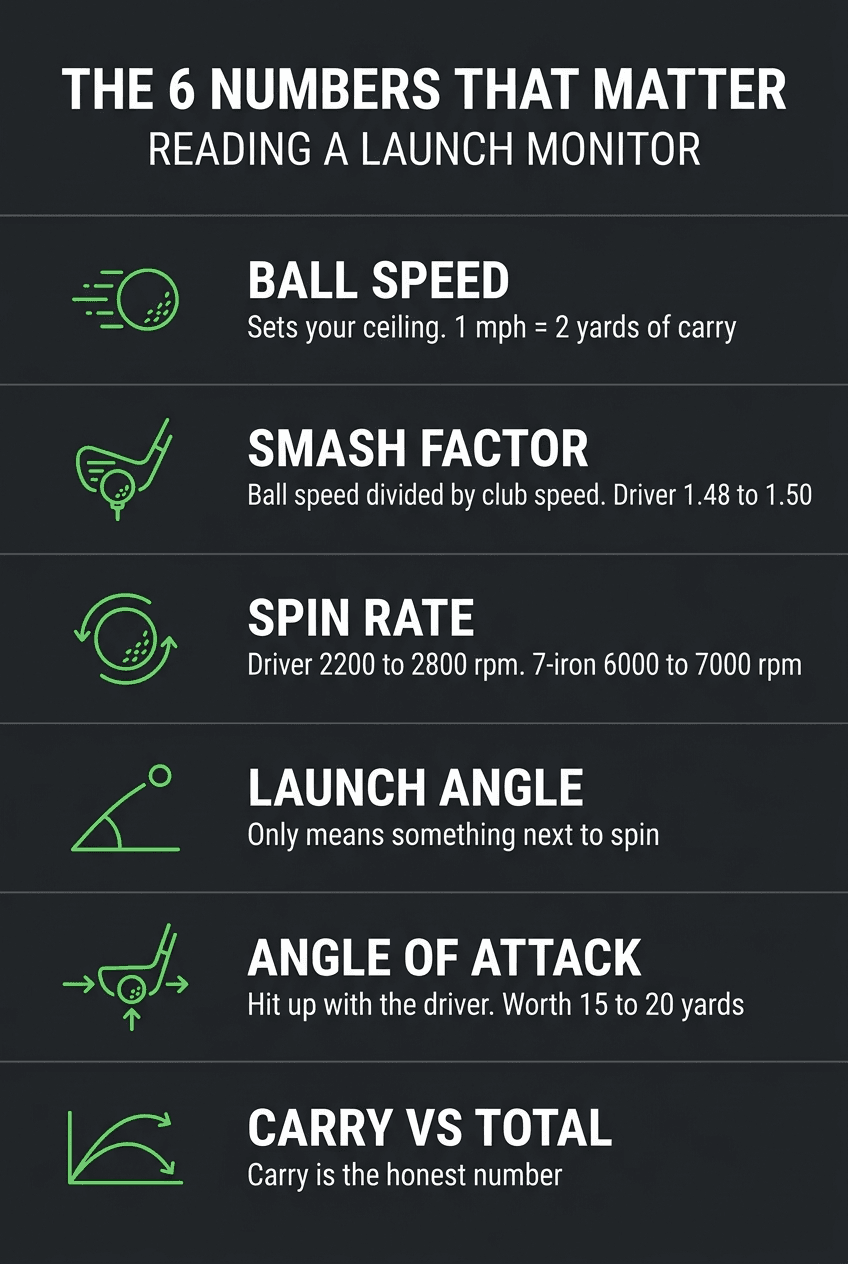
Here is the short version, then the detail. Ball speed and smash factor tell you how well you are transferring energy. Spin and launch angle tell you what the ball does in the air. Angle of attack is the free-distance lever nobody talks about. And carry is the only distance number you should trust. Everything else on the screen is either a swing coaching cue or noise dressed up as data.
Ball speed: the number that sets your ceiling
Ball speed is how fast the ball leaves the face, and it is the single best predictor of how far a shot can go. Club head speed gets all the attention on TV, but you can swing fast and still lose ball speed by catching the ball off the heel or thin. A driver ball speed in the low 130s mph roughly lines up with 240 to 250 yards of carry when the launch and spin are sensible. Every 1 mph of ball speed is worth about 2 yards, so this is the number worth chasing.
One caveat that keeps people honest: a single monster swing means nothing. Hit five or six and read the average. Launch monitors reward you for your best strike, and your best strike is not your Tuesday afternoon strike. If your ball speed swings wildly across a session, that is a centeredness problem, and a more forgiving head will do more for you than more loft or a different shaft.
Smash factor: are you leaving speed on the table
Smash factor is just ball speed divided by club speed, so it measures how efficiently you turned swing speed into ball speed. With a driver the ceiling is around 1.50, and good drivers of the ball live near 1.48 to 1.50. Irons are lower by design because of the loft, so a 7-iron around 1.33 is normal and nothing to worry about.
Why it is useful: if your club speed is 100 mph but your smash is 1.40, you are only getting 140 mph of ball speed when you could be near 148. That gap is almost always a strike issue, sometimes a shaft or head that does not fit. A fitter will use a low smash number to justify a new driver. Sometimes they are right. Sometimes you just need to find the center of the face, which is free.
Spin rate: the setting most golfers get wrong
Spin is where drivers are won and lost. Too much backspin and the ball balloons, climbs, and drops short. Too little and it falls out of the sky with no carry. For most golfers a driver spin somewhere in the 2200 to 2800 rpm range is the sweet spot, with slower swings living at the higher end because they need spin to hold the ball up. Faster swings usually want less.
Irons are the opposite story. There you want plenty of spin so the ball stops on the green, which is why a well struck 7-iron might spin 6000 to 7000 rpm. When you read a driver session, high spin is the most common problem, and it is often fixable without buying anything. A stronger loft setting, a slightly forward tee, or a small change in where you catch the ball on the face can drop spin by hundreds of rpm.
Launch angle: only useful next to spin
Launch angle is how steeply the ball leaves the face, and on its own it tells you almost nothing. It only means something paired with spin. The combination you want off a driver is high launch with low spin, because that is what carries far and rolls out. A launch around 13 to 16 degrees with spin in that 2200 to 2800 window is the profile fitters are steering you toward, and it is worth knowing so you can tell when they have actually found it versus when they are still fishing.
If your launch is low and your spin is high at the same time, that is the worst pairing in golf. The ball climbs late instead of early and dies. It usually points to hitting down on the driver, which brings us to the number that fixes more than any club ever will.
Angle of attack: the free yards nobody mentions
Angle of attack is whether the club is moving up or down through impact. With irons you want to hit down, which is why your divot is in front of the ball. With a driver you want the opposite. Swinging up on the driver, even a few degrees, launches the ball higher with less spin, which is exactly the profile you are after. Moving from a couple of degrees down to a couple of degrees up can add 15 to 20 yards without a single mph of extra speed.
This is the number to watch if your driver numbers look bad no matter what head you try. A fitter can hand you every driver in the rack and none of them will fix a steep, downward driver strike. Teeing the ball higher and playing it forward in your stance is the cheapest 15 yards in the game, and the launch monitor will show it happening in real time.
Carry vs total: trust the honest number
The big glowing total distance is the number everyone screenshots and the one you should trust least. Total distance assumes a rollout the machine invented based on a firm virtual fairway. Carry is the real number, because carry is the ball flying through the air, and air does not care whether the range is wet or the fairway is baked out. When you compare two clubs or two sessions, compare carry. When your buddy claims 290 off the sim, ask what his carry was, then watch the number get a lot more reasonable.
The numbers to ignore, or at least not obsess over
Club path and face angle matter for where the ball goes, but they describe your swing, not your equipment, so they belong in a lesson rather than a fitting. Spin axis and shot curve are the same idea. And any number that shows up for one swing out of ten is not data, it is a fluke. Read averages, watch the six numbers above, and you will understand a launch monitor better than most of the people standing behind one.
None of this replaces getting fit by someone good. It just means you can tell when the fitting is working, push back when a number looks off, and walk out knowing why the club they recommended is actually better for you. That is the whole point of the data. Our club rankings are built on the same launch numbers, so once you can read a screen, the reasoning behind a recommendation stops being a mystery.
Frequently Asked Questions
What ball speed do I need to carry a driver 250 yards?
Roughly 130 to 135 mph of ball speed, assuming your launch and spin are in a sensible range. Ball speed sets the ceiling, and each 1 mph is worth about 2 yards of carry, so a poor strike that bleeds ball speed costs distance even at a high swing speed.
What is a good smash factor?
About 1.48 to 1.50 with a driver, which is close to the physical ceiling of 1.50. Irons are lower because of loft, so a 7-iron near 1.33 is normal. A low driver smash usually means an off-center strike rather than a bad club.
Is high spin or low spin better off the driver?
Most golfers spin the driver too much. A range of about 2200 to 2800 rpm suits most players, with slower swing speeds toward the higher end. Too much spin balloons the ball and costs carry; too little makes it fall out of the sky.
Should I look at carry distance or total distance?
Carry. Total distance includes a rollout the launch monitor estimates from a virtual firm fairway, so it flatters your numbers. Carry is the ball actually flying, which is the honest way to compare two clubs or two sessions.
Why does the fitter care about angle of attack?
Because hitting up on the driver launches the ball higher with less spin, the exact profile that carries far. Moving from hitting down to hitting up can add 15 to 20 yards with no extra speed, and no new driver can fix a steep downward strike.