Cavity Back vs Blade Irons: A 2026 Buyer's Decision Guide
Cavity backs forgive misses, blades reward strikers. Here's the real difference in performance, dispersion, and feel, and which style fits your handicap and swing.
May 27, 2026
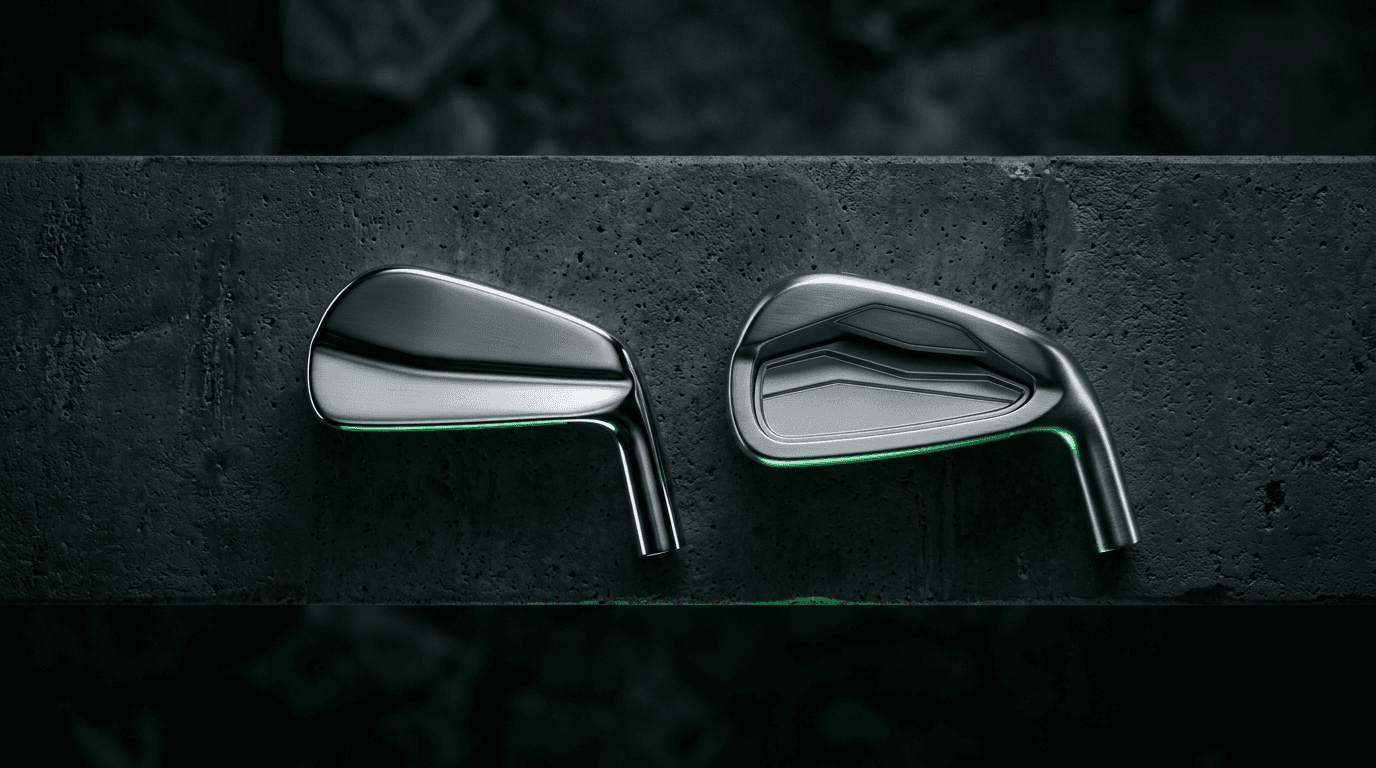
Blade and cavity-back side by side, the geometry tells you everything about who each one is built for
The Core Difference, Plainly Stated
The terms "cavity back" and "blade" describe where the iron's mass sits inside the head, and that mass placement determines almost everything else about the club's performance. A blade, properly called a muscle back, concentrates the mass directly behind the sweet spot, in a solid bar of metal that runs the length of the clubhead. A cavity back removes mass from behind the sweet spot and redistributes it around the perimeter of the clubhead.
Both designs hit a ball the same way at the center of the face. The difference shows up the moment the strike moves off center. A blade loses ball speed and starts twisting on a toe strike. A cavity back, with its weight pushed to the edges, twists less and loses less ball speed on the same miss. That single principle of perimeter weighting equals forgiveness, and it drives the entire conversation around iron selection.
What Forgiveness Actually Means
"Forgiveness" is a term thrown around in every iron review, and most golfers have only a vague sense of what it measures. The technical definition is moment of inertia, or MOI, the head's resistance to twisting on off-center strikes. A higher-MOI head twists less when struck off the toe or heel, which means the face stays closer to square and the ball speed drops less.
In numbers: a typical muscle-back blade has an MOI in the range of 2,200 to 2,800 g/cm². A modern game-improvement cavity back can exceed 3,500 g/cm² in the longer irons. That difference translates to roughly 4 to 8 yards of distance loss on a heel-side miss for the blade, versus 1 to 3 yards for the cavity back. Over 18 holes, that variance is the difference between a green hit at 165 yards and a chip from 12 yards short.
MOI alone doesn't capture everything, though. Cavity backs also use thinner faces and wider soles, both of which contribute to higher ball speeds across the entire face, not just at the center. The combination is why a mid-handicapper hitting a cavity back will typically see a 6 to 12 yard tighter dispersion pattern than the same player with a blade.
What Workability Actually Means
Workability is the inverse story. A blade's low MOI is also why it "works" - the head is more responsive to swing path and face manipulation, which means the player who can deliver the club consistently can also shape the ball intentionally. A draw, a fade, a low stinger, or a high cut becomes a matter of small swing adjustments.
Cavity backs can be worked too, but the high MOI fights against the manipulation. A wider sole and perimeter weighting want to produce a neutral, slightly draw-biased trajectory every time. For a low-handicap player who depends on shaping shots into specific green positions, that consistency is a feature only when it matches the desired shot. When it doesn't, when the player wants a low fade and the iron wants a mid-high draw, the cavity back becomes the limitation.
For most amateurs, this trade-off is theoretical. The vast majority of golfers don't intentionally shape shots round to round. They aim at flags, swing as consistently as they can, and accept whatever shape comes. For that player, the cavity back's consistency is the upgrade and the blade's workability is irrelevant.
Feel: The Sound and the Hand
Blades feel different from cavity backs at impact in two ways: the sound and the haptic feedback through the hands. A pure strike with a blade produces a soft, low-pitched click and a buttery sensation in the hands, many tour players describe it as "feeling nothing", which is meant as a compliment. The mass behind the sweet spot absorbs vibration so cleanly that the ball seems to leave without resistance.
Cavity backs produce a sharper, slightly louder sound and more vibration through the hands. The hollow construction reflects acoustic energy differently. Modern players' cavity backs (Mizuno JPX, Titleist T150) have closed much of this gap with internal sound chambers and dampening materials, but the underlying difference remains. Game-improvement cavity backs in the same class as the Callaway Apex DCB or the TaylorMade Stealth Max will feel noticeably more "clicky" than a true blade.
Feel is not a performance metric, but it matters because confidence at address translates to swing tempo. A player who loves the feel of a blade will swing with more conviction than the same player playing an iron they find harsh. For the right golfer, the feel argument is more than aesthetic preference.
Off-Center Misses: Where The Gap Is Widest
The honest story about iron selection comes down to what happens on bad swings, not good ones. The two heads behave almost identically when the strike is pure. The gap widens fast when the strike isn't.
On a typical toe miss with a 7-iron:
- Muscle-back blade: Ball speed drops 6 to 9 mph, launch angle drops 1 to 2 degrees, distance loss is 12 to 18 yards.
- Mid-handicap cavity back: Ball speed drops 3 to 5 mph, launch angle stays within 0.5 degrees, distance loss is 5 to 9 yards.
- Game-improvement cavity back: Ball speed drops 1 to 3 mph, launch angle barely moves, distance loss is 2 to 6 yards.
The same pattern holds on heel strikes, with slightly different numbers. The point is the spread. A blade penalizes mis-hits 2x to 4x more than a cavity back. For golfers who regularly find center, that penalty is rare. For golfers whose strike pattern varies, the penalty is the difference between a playable round and an unplayable one.
Who Should Play What
The fitting answer to the cavity-versus-blade question almost always reduces to two variables: handicap and strike consistency. Handicap is a proxy for skill across all dimensions of the game. Strike consistency is a proxy for how reliably the player delivers the club face to the center of the iron.
Should Play Blades
- Single-digit handicappers with a consistent center-pattern strike.
- Players who actively shape shots and rely on workability in scoring zones.
- Tour-level or elite amateur players who prioritize feedback and feel over forgiveness.
- Golfers whose practice and competition volume justifies high-precision tools.
Even within this group, many tour players combine blades in the short irons (8-iron through pitching wedge) with players' cavity backs in the long irons (4 through 7), specifically because the forgiveness gap on a long-iron miss is too punishing even for elite ball-strikers.
Should Play Cavity Backs
- Mid-handicap players (8 to 18) who want consistency over shot-shaping.
- High-handicap players (18+) who need maximum forgiveness across the face.
- Senior golfers who have lost some swing speed and need help getting the long irons in the air.
- Anyone whose practice volume isn't high enough to maintain a tour-level strike pattern.
Within cavity backs, the further distinction is between players' cavities (T150, JPX Tour, P790), mid-cavities (T200, JPX 925 Forged, Apex), and game-improvement (T350, JPX 925 Hot Metal, Stealth Max). Each step toward game-improvement trades workability and feel for additional forgiveness and ball speed.
Combo Sets: The Pragmatic Middle
The modern fitting reality is that most golfers under a 5 handicap should be playing a combo set, blades or players' cavities in the short irons, mid-cavities or game-improvement in the long irons. The shorter irons are where workability and feedback pay off. The longer irons are where forgiveness matters most.
Most manufacturers explicitly support combo sets within their iron families. The Titleist T series (T100/T150/T200/T350) interchange seamlessly. The Mizuno JPX series, the TaylorMade P-series, and the PXG GEN6 are all designed for mix-and-match within the same set.
A common high-skill combo: 4-iron through 6-iron in the T200 (mid-cavity), 7-iron through pitching wedge in the T150 (players' cavity), gap and sand in muscle-back wedge designs. This is the modern interpretation of the old "players use blades" wisdom, pure blades for full sets are increasingly rare, even on tour.
How GolfSource Scores The Two Categories
Our MatchScore engine treats blades and cavity backs as fundamentally different player archetypes rather than competing answers to the same question. The scoring model weights forgiveness, launch consistency, and dispersion higher for mid-handicap and high-handicap profiles. It weights feedback, sole grind options, and workability higher for low-handicap profiles. A player rated at a 15 handicap who selects a muscle-back will see a lower MatchScore than the same player selecting a cavity back, not because the muscle-back is a worse iron, but because it's a worse fit for that player's profile.
Run your own profile through Find My Iron and the right category surfaces in the rankings. If the top three results are all cavity backs, the engine is telling you something about your strike profile and swing speed that marketing copy can't override.
What To Test Before You Buy
If you're between categories, hit both at a fitting and pay attention to the spread rather than the peak distance. A blade and a cavity back hit purely will produce similar carry numbers. The difference is in dispersion across 15 to 20 swings.
Watch for:
- Carry distance spread: If your blade carries vary by 25+ yards and your cavity backs vary by 12 yards, the cavity back is the right answer.
- Direction spread: Heel and toe misses pull and push significantly more with a blade. A wider direction spread is a tell.
- Confidence at address: If you stand over a blade and feel hesitation, that hesitation will produce decelerated swings in real rounds. Pick the iron you can swing freely.
- Long iron performance: The forgiveness gap is widest in the 3, 4, and 5 irons. Test those, not just the 7-iron.
The 2026 Examples Worth Knowing
A few representative iron families across the spectrum:
- Pure blades: Titleist 620 MB, Mizuno Pro 241, Callaway Apex MB.
- Players' cavities: Titleist T150, Mizuno Pro 245, TaylorMade P790, Ping Blueprint S.
- Mid-cavities: Titleist T200, Mizuno JPX 925 Forged, Callaway Apex (standard), TaylorMade P770.
- Game-improvement: Titleist T350, Mizuno JPX 925 Hot Metal, Callaway Apex DCB, Ping G440.
Each step from left to right adds forgiveness and ball speed and subtracts workability and feel. Pick the column that matches your handicap and your strike pattern, then test the specific models within it for fit on shaft, lie, and length.
The Bottom Line
The cavity-back-versus-blade conversation has become a marker of golfer ego more than a fitting question. Most golfers who play blades shouldn't, and they're costing themselves strokes for the look at address. Most golfers who play cavity backs are playing the right tool for their game and shouldn't be persuaded otherwise.
Pick the iron that fits your strike pattern and your handicap, not the one that fits your self-image. Test under realistic conditions, watch dispersion not peak distance, and trust the data. The right iron is the one you can rely on across a round, not the one that looks right in a photograph.
For a sharper take on specific iron sets in 2026, the best irons for mid-handicaps guide breaks down the strongest options across the cavity-back spectrum, with MatchScore rankings for each.